Monday, March 30, 2015

Let Your Child Marinate in Words

If you are anywhere near a public school you can feel the test anxiety.  It makes me crazy and of course I have my opinion of how it could be handled and not stress everyone out!  BUT  I will save that for another day.

While visiting with some kindergarten teachers about their students and test results, they realized one of the areas that was particularly low was vocabulary.  Personally I believe it's a tricky thing to test, especially on a computer, but the world testing powers  didn't ask me.  Now we can argue the merits of even taking a test on a computer and all the variables that are at play, but again we will save that for another day.

The teachers and I were talking about how to teach or really expose children to vocabulary.  Because the words are random, you can't 'preteach' every word.  A word that is on the assessment one month may be randomly replaced with a different word the next month.  So what to do?

Ideally all children will come to school with a vast vocabulary.   While that would be great it doesn't happen.  Parents are overwhelmed and intimidated by vocabulary - and you shouldn't be.  What is important is to expose children to words.  So to start with,  just talk to your child.  When I say talk to your child, I mean use your grown up voice.  Don't talk baby talk to your child.  Look for opportunities to use real words rather than made up silly words.  For example, if your child has a scratch, instead of saying, Oh you have an ouy or a boo boo, try saying,  Oh you have a scratch.  I can guarantee your child will only encounter boo boo at your house but will encounter scratch everywhere else.  Sometimes a food can be yummy, but it might be luscious, or tangy or spicy.

The more children are exposed to words the more likely they will pick them up.  If you don't believe me think about a word or words your young child has repeated that you know you didn't teach him or her.

Think about synonyms for words you probably over use.  Do you always tell your daughter she looks pretty? Does she ever look glamorous, or sophisticated, or beautiful or spunky?  What about your son?   Does he ever look dapper?

What are some other ways to say good game or you played well.  We know from research that children respond better to specific language, for example I like the way you caught that ball instead of good job. Perhaps the game was intense, or a nail biter.

With the warmer weather, it's an ideal time to be outside observing nature.  Everything isn't a bug! There are crickets and grasshoppers and cicadas.  Some are insects and some are not.

Maybe at the store there weren't a lot of people,  maybe there were hordes of people or maybe it was a throng of people.

One of the easiest ways to increase your child's vocabulary is to read good literature to them.  Some of my favorite authors are listed on my blog site.

When we marinate meat, we let it sit for hours, soaking up the rich marinade.  That's what we want to do with words and our children.  Let them soak up or marinade in words.  I promise not only will it  pay off on test day, your kids will have a vast vocabulary!

Monday, March 16, 2015

Crocheting and Kids

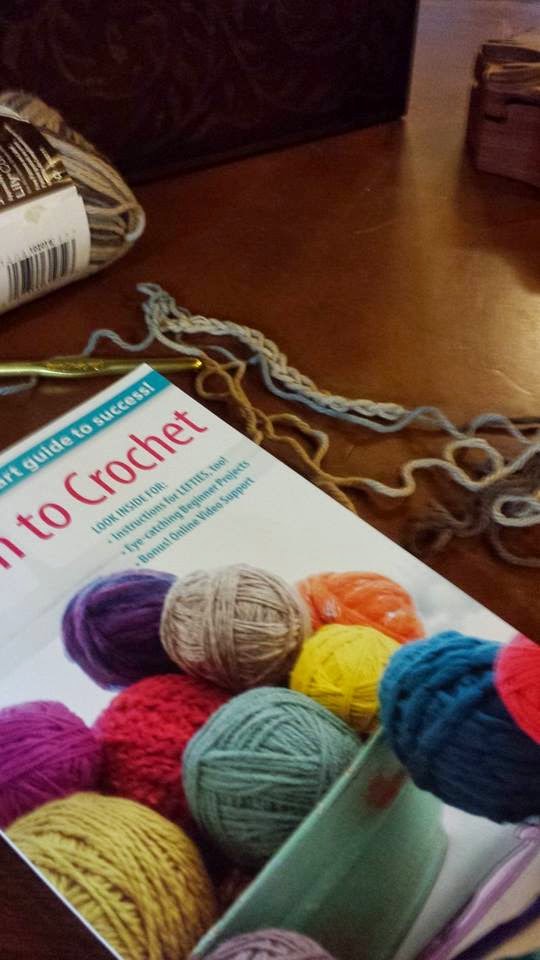
I learned to crochet last week.  Well, I began learning how to crochet.  My sister crochets beautiful things - scarves, afghans, hats all sorts of things.  My mother in law crochets too.  She has entered some of her things in the State Fair.  Both of them have told me how fun and relatively easy it is to learn.  For thirty five years I have told my mother in law the issue is I am left handed and she is right handed therefore making it very hard for me to learn.   It wasn't that I didn't want to, I envisioned myself many times sitting, watching television and my fingers nimbly working the yarn and the hook. It was that I knew it was going to be hard.  My sister called one day and told me she had bought a book on beginning crocheting that had left handed instructions.  YAY!  She would teach me during our week in Estes Park.  I really was excited and just knew that by the end of the week I would be turning out a beautiful afghan.  My three children would fight over who got mom's first afghan!

The lesson began - I was ready.  Yarn in one hand, hook in the other.  The first thing my sister noticed was that I wasn't relaxed.  My fingers were too tight and up close to the end of the hook. Apparently that was not good.  My project was a coaster.  According to the directions I would be able to whip one out in about an hour.  My sister was very patient.  She would lovingly say, Well, let me see what you have done.  She repeated that phrase over and over and over and over again.  She, being a retired educator, was extremely supportive and kept telling me it looked great. (It really didn't.)

After 7 hours and all I had accomplished was the first row or foundation, my dreams of my children arguing over who would get my first afghan were dashed.  I must have ripped that first row out a hundred times.  Either the loops were too tight or too lose or there was what looked like a growth coming out of the side.  She would say, leave it, it's ok.  But I knew it wasn't.  I was determined so the next crocheting time came and I was at it again.  Deciding maybe it was the cotton yarn, I switched yarns and it did seem much easier.  I made my second coaster in about an hour compared to the 36 hours for the first!

Ever more determined I started on my third coaster.  Could I possibly have a set of 4 before I left to go home?  I was starting to get excited.  I really had learned to crochet!   All along my sister would periodically ask, What do your instructions say?  I had it down, I stopped following along.  My third coaster was the best so far until it was time to finish the edges.  I had forgotten to look at my instructions so instead I snipped the yarn.  I realized quickly I still needed that yarn to do the slip stitch around the edges. I won't repeat what I said.  Always the educator my sister said, Really, it's okay.  We can just tie this together and you are set.  I told her I would do that later and that I was going to do my fourth coaster so I would have all four.

Here's the deal.  It was really, really hard.  I would sneak a peek at my sister crocheting and her fingers were just as relaxed as could be.  She could even visit while she worked!  I wanted to quit, several times.  I thought, I could pay  YOU to make my dumb coasters!  But I didn't.  I kept at it.  I posted my progress on Face Book and loving friends encouraged me, even though I know in their minds they were thinking Oh my gosh!  

I do not recommend you teach your child how to crochet.  Although they might be better than I am. But it reminded me of how hard it is for young children to learn new things.  I learned because my sister provided a scaffold for me.  She walked me through it, she modeled it for me.  She did a little and said, Now, you try it, all the while watching.  She kept encouraging me over and over again.

I think we do a disservice to children when we don't provide that scaffold.  When we don't encourage them all along the way.  When we don't do a little and say, Now you try it.  I think we do an even bigger disservice when we think they will learn something and be great the very first time, not giving them time to practice their craft.  It's a disservice to not realize how hard learning is, regardless of the content.

So....when you teach your child something or they come home from school discouraged about not being able to learn something, remember learning is very, very hard!  Remind them of that too!


Monday, March 2, 2015

The geranium on the windowsill just died...

This is one of my favorite poems by Albert Cullum.  I think sadly it sums up a lot of classrooms, including preschools and day cares.

If you live in the Dallas/Ft. Worth area  you are probably tired of the snow, ice, dreary, cold weather. I hate to complain too much when I see what Boston keeps getting.  We had two snow days last week.  Then Friday, it snowed while everyone was at school, preschool and work.  As I watched all the schools and day cares post they were in session, I hoped that the teachers and care providers would throw schedules to the wind and let the children go out and experience the snow.

Now before my teacher friends remind me that there is a high stakes test lurking around the corner and everyone has standards and common core and blah, blah, blah, I have been on enough campuses and have been in education long enough to know that there are days when time is wasted...for whatever reason or no good reason.

There are great teachable moments that happen and as teachers and care providers we need to be aware of them, be alert to them and respond to them.  A few minutes to go out and touch the snow is not going to harm any child educationally.  It may do a lot of good, it may allow for some great oral language, it might even build a positive memory.  If 5-10 minutes of going outside to experience snow destroys a program then the program has other problems.

Parents, check out your child's daycare and school  How do they respond to those spontaneous things that happen?  When it snows where are they? Inside or outside?

As a parent did you take your kids out on the stay home days to play and experience the snow?

Obviously school and work are very important and I do not subscribe to people 'skipping' out  just because.  But life is short and there are times to build memories.  In 1999, the Texas Rangers were playing Seattle during the day.  My son was in 6th grade at the  time.   Ken Griffey Jr. was his favorite player and played for Seattle.  What could be better than his favorite team playing his favorite individual player.  It was the last game of the season, it was the last game of the millennium  it was just too important a game to miss, at least to a 6th grader.  We struggled with what to do.  My husband was in favor and I was not.  I was a teacher, how could I condone missing school for a game?  My husband won and came up with a 'dentists' excuse.  So now, not only was he missing school we were lying about it!  Half way through the day I felt so guilty that I called the school and confessed where they really were.  After some fun, at my expense, the principal told me she was glad we had done that.  Blake would remember that far longer than anything taught that day.  She also said that if missing one day was going to set him behind we had bigger issues.   Her comments have stayed with me!  Guess what, he still talks about the day he missed school to go see the Texas Rangers play Ken Griffey Jr.  I don't recall him talking about a regular day at school the same way.

I know attendance is very important.  Kids needs to be in school, kids need to be in preschool or Mother's Day Out or where ever you have your children.  But there are things that happen in life that we need to seize and enjoy.  Perfect attendance doesn't really build memories.

So when the geranium dies, please don't just go on.


Wednesday, February 18, 2015

What do Valentines, buttons and keys have in common?

Soooo, you bought the Valentine cards for your child to pass them out at school and it seems you have twice as many left.  I swear they multiply.  But don't throw them away just yet.  Get a couple of pairs and you have a matching game or memory game.  This type of game is great for children's basic memory as well beginning to focus on how things are alike and different.  For young children you really only need 4-6 pairs.  More than that for 3-4 year olds and it is overwhelming.  Another idea is to put the leftovers in a pile and ask your child to sort them, put them in groups.  You can model by saying, Let's put these in a group, they are all Hulk cards.  These are all Spiderman cards, These are all rectangles, etc.  How about sorting the cards by the number of words This is the beginning of learning about attributes or characteristics of things.  We sort by attributes, like color, shape, size, etc.  It's interesting to see how your child sorts the cards. Be sure and say things like, These go together because they all...Do you see any others that could go in this group?
on the card!
Take 3-4 different cards, cut them in half and have your child put them back together.  Cut each card in 3 and you have very easy puzzles.
Extra cards can also be used to start stories.  Get 3 cards and make up a story using all three cards. Encourage your child to add to the story.

My children accuse me of hoarding things.  I really do not, however, I do hold on to things a lot of people might not.  I have a drawer of those extra buttons that come on clothing, buttons that have fallen off and just buttons I find.  In my defense, buttons are one of the greatest things to use with children. You can sort them by color, size, number of holes and use them for counting.  When  my grands are here, we can sort and count.

How about all those keys you no longer remember what they unlock?  Another great tool for sorting. Kids come up with very creative way to sort keys.  Get a key and make up a story about what it unlocks or to whom it belongs.  Ask your child to  make a set of 2 keys, 3 keys, etc.

Everyone has coffee stirrers!  I love to use both keys and stirrers for measuring things.  Ask your child,  how many coffee stirrers long is the table?  How about the chair?  Your toy?  Kindergarten children are expected to know how to use nonstandard units of measure.  They can't understand inches, feet and yards until they just understand measuring, period.  Keys, paper clips, sugar packets are all great nonstandard units to use.

See?  I can tell you are thinking of other ways to use these ordinary things.

Monday, February 9, 2015

No data - just a gut feeling

Do you ever get tired of all the research people throw around?  I know I do.  I learned too that there is research for everything!  Sometimes I read a research title and think, Really!  Someone actually wanted to know about that?  Someone spent time researching that? Now,  do not get me wrong, there is research that is needed and valid.   But what I learned early on about some research is that it is done by the company touting something and has never been replicated.  What I mean is a particular company may be saying glowing things about their product and spouting research that supports great results.  Great, you say.  However, what they don't tell you is that they are the only ones who did the research on a controlled group and it's never been conducted by an outside, independent source - replicated.

I love research, truly I do, but I love common sense and following our gut too.  It's hard to present facts or data based on 'gut feelings' but I think they are just as important.  I have said it before I think it's hard to raise a child today.   Everywhere you turn someone (even me) has an opinion, a social media site, a blog,  a website, it's crazy!  If you follow anything on the political scene with public education you have certainly realized there is no common sense either!

We know colleges now look for students to be 'well-rounded.'   They don't want the straight A student with the perfect GPA who did nothing but study (they probably want a few).  They want kids who have volunteered, who have 'given back', they are looking for kids who played sports in addition to getting good grades.   In other words, they want kids.

So if we know this, why wait until their high school years to start this?  When a young adult tells me, Oh I need to do this volunteer program because it will look good on my college application, I am tempted to say, Please don't bother. You see, to me, they are doing it for the wrong reason, they are doing it for the application not because it is a kind, thoughtful thing to do.

If we want kids to be life long givers, then let's start them participating in volunteer things as soon as they can.  Teach them how to write thank you notes.  Have them gather up old toys or clothes and actually take the clothes to a Clothes Closet or Goodwill, not out on the curb.  Choose a Salvation Army angel and let them go help buy the gifts.  If they are raising money for a cause, let them give some of their allowance to the cause too and not just collect from friends. Let them help serve breakfast at a shelter.  I think the list is endless.

I don't have any hard data from research that starting a child out early to volunteer and give back creates a life long giver or that it creates a more compassionate adult.  It makes sense though to me and I have a gut feeling it may be true.  Maybe if we started our kids out at an early age to care about others and not wait until they are seniors and need 'volunteer hours' for an application, our world would improve.  No data, just a gut feeling.

Thursday, February 5, 2015

Fight for your child....nobody else will

In the last week I have had two examples shared with me about what I would consider 'bullying'.  It is easy to dismiss most things until they happen to you.  All of a sudden when it's your child that is the recipient, it isn't quite so silly, or the current buzz word, it's real.  When it's your child, it's hurtful and upsetting.
Let me make a little disclaimer, while I think bullying is unacceptable, I also believe the Zero Tolerance attitude is a little unrealistic, out of control and should be thought through depending on the age of child or number of times of offenses.  I don't believe a 1st grader should be in isolation the first time he/she bullies another.  Typically a bully has other issues that need to be addressed.

The first incident was with my grandson.  He came home from school and was obviously 'out of sorts'.  His behavior was seriously not consistent with his usual 'happy to share his day' attitude.  In fact, according to his mom it bordered on downright rude and belligerent.  When he had a full fledged meltdown she asked if he had had a 'rough' day?  (Ya think???)  He quickly informed her he didn't want to discuss it.   She left it alone.  When his dad got home he had calmed down enough to discuss it.  Apparently there was a child being a bully to Parker at school.  It was occurring during lunch and the recess following.  Now, you and I would probably laugh at being called a 'water head'  or 'ground beef',  but to a sensitive 6 year old it was upsetting. Being shoved in the back as he was walking was upsetting as well.  Parker and his parents discussed it and told him to ignore the bully.

What concerned me (in addition to MY grandson being picked on) was my daughter's initial reluctance to contact the teacher.  She finally did with some encouragement and the teacher was appreciative.  The bottom line was Parker didn't realize he could tell another teacher/lunchroom monitor on duty something that was going on.  Add to that we emphasize to our kids not to tattle. They hear that at home and they especially hear it at school.  The consequence of that is they don't know what to do and they internalize it.

As teachers, we don't want kids coming up all the time 'tattling' so we come up with clever little sayings like only interrupt/tattle if it's one of the three B's - blood, barf, body (part).  We think those are so clever but we many times don't realize how we silence a child who needs to share about a bully.  The child comes home, shares and it is up to  the parent, the comforter, to address it with the school.

The second example of bullying was actually done in my opinion by a teacher,  No, names weren't called, nobody was pushed in the back however, in a sense a teacher bullied a child.  According to the definition of bullying: Bullying is the use of force, threat, or coercion to abuse, intimidate, or aggressively dominate others. The behavior is often repeated and habitual.

Teachers many times use rewards and consequences to stop negative behaviors.  These are typically harmless.  My problem is that many times the consequence is not age appropriate thereby making it impossible for a young child to meet.  There is so much research on age appropriate consequences that teachers should know better.  In this situation, a child was denied the opportunity to participate in an extra 'fun' day.  I can go along (sort of) with not getting to participate if the teacher had said, If this behavior continues, then you won't get to participate tomorrow.  BUT, in this case the child didn't get to participate in an event at the end of the week based on behavior several weeks prior. As a 5 year old, she was to remember a reward three-four weeks out.  (I might add the reward was secret.)   Kindergarten children have no concept of time.  They aren't being stubborn and choosing to not understand time, their little brains aren't developed yet to grasp the concept of time. So having them work towards something 3-4 weeks out is ludicrous. Add to that the  'offense' was extremely vague. 

Again, my concern was that the parents, although divided on how to handle it, didn't feel they should fight for their child.  They made the best of a bad situation but the child is confused about behavior and consequences.  What she has learned was that you pay the price today for your behavior, but at the end of the month you may get penalized again - surprise.  She learned that a teacher has the power to decide what happens and change the rules in the middle of the game.

With consequences we know they have to be immediate, or they lose their effectiveness and they have to be age appropriate.  The expectations have to be clear. These parents owe it to their child to talk to the teacher and make their displeasure and disagreement made known.  They aren't arguing with her daily discipline but with this secret, unknown motivational reward.  The child clearly knows and understands the daily rules and consequences. Yes, life isn't fair but they will learn that in good time and don't need to learn it in kindergarten.

Teachers make mistakes, not intentionally but we do.  We use our power sometimes against kids when we are tired, frustrated or don't know better.  As parents we need to fight for our child, call the teacher out.  

Other kids can be mean.  Yes, we need to teach our children to ignore bullies, but we have to stand up for our kids too and let the teachers know.

I am passionate about kids (and adults) being treated nicely by other children and teachers.  Life is short, hug your kids!


Tuesday, January 20, 2015

Mean Moms

My daughter was ranting the other day about the 'mean moms' at the dance studio.  They huddle in a corner and apparently discuss the little dancers.  Keep in mind they are 3 and 4 so they are really not dancing, but figuring out how to move across a floor on tiptoes and leaps while staying upright.  I am not knocking it at all, I love little dancers.  BUT they are brand new dancers, they have only been alive 3 or 4 years!   TOTAL!  They recently learned how to walk!

Is this a tendu?

Now to be fair, these moms talk about their own daughters too.  This always bothers me because many times, these girls will grow up to be the "mean girls" in school.  

We can teach our children to be kind and compassionate.  I love this from NAEYC10 Tips for Raising a Compassionate Infant, Toddler:
 Recent research shows that infants and toddlers are far more empathetic than we once thought.  While they have short fuses, and don’t cope well with sharing, they are capable of being compassionate. 

The article mentions 10 things parents can do to raise compassionate children. I didn't read talking ugly about other children as one of them.   Lots of easy things to do, but my favorite is #1.

I tell ya, that modeling the right thing is hard!